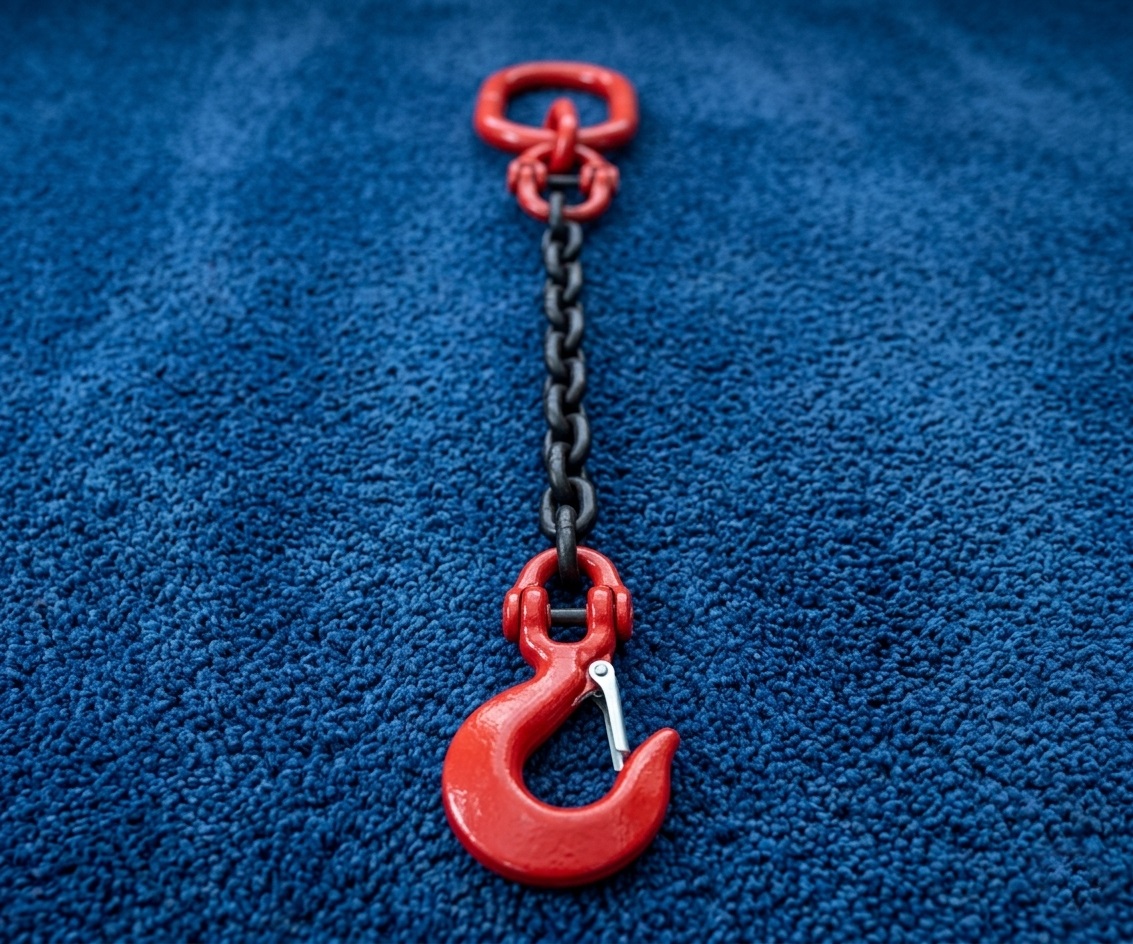
1 LEGGED CHAIN SLINGS
What is a Single-Legged Chain Sling?
A single-legged chain sling (often referred to as a single-leg chain sling) is
a heavy-duty lifting assembly consisting of a single length of high-strength
alloy steel chain rated for overhead lifting. It features an upper master link
(or oblong ring) at one end for attachment to a crane or hoist hook, and a
terminal fitting (such as a latch hook, self-locking hook, or grab hook) at the
other end to secure the load.
These
slings are typically manufactured using Grade 80 (T) or Grade 100 (V)
alloy steel, which provides the necessary tensile strength, durability, and
resistance to wear required for industrial rigging applications.
1. Technical Features
- High-Strength Alloy Steel
Construction:
Usually fabricated from Grade 80 or Grade 100 chain, offering an excellent
strength-to-weight ratio and a standard 4:1 safety factor.
- Modular Design: Components like coupling
links (mending links), master links, and various hooks can be easily
interchanged or replaced if damaged.
- Temperature Resistance: Highly resilient to extreme
environments. They can operate at elevated temperatures (often up to 200°C
/ 400°F without reduction in Working Load Limit, and up to 400°C /
750°F with a reduced load rating).
- Identification Tag: By regulation (OSHA/ASME),
every sling comes equipped with a durable metal tag detailing its size,
grade, reach, and Working Load Limit (WLL) across different
configurations.
- Flexibility and Reach: The single leg can easily
wrap around or hook into specific lifting points, making it highly versatile
for singular point connections.
2. Common Uses and Applications
Single-legged
chain slings are foundational tools used across several rugged sectors:
- Manufacturing &
Engineering:
Moving heavy machinery, steel plates, or large castings around factory floors.
- Construction Sites: Lifting structural steel
beams, concrete pipes, pre-cast panels, and heavy tools.
- Foundries & Steel Mills: Transporting materials
through high-heat environments where synthetic or wire rope slings would
melt or degrade.
- Cargo Handling &
Shipping:
Securing and loading freight at ports, docks, and rail yards.
- Automotive & Repair
Shops:
Hoisting engines, chassis parts, and heavy sub-assemblies.
3. Key Advantages
- Extreme Durability: Unlike web slings or round
slings, chain slings are highly resistant to cuts, abrasions, sharp edges,
and UV degradation.
- Long Service Life: With proper care, routine
inspection, and maintenance, alloy chain slings can last for decades in
harsh industrial environments.
- Easy Inspection: Damage such as elongation
(stretching), nicks, or gouges is relatively easy to detect visually or
with simple measuring calipers.
- Repairability: If a single component or
part of the chain fails or wears out, the specific section or hook can
often be replaced and recertified without discarding the entire sling.
- Compact Storage: They can be loosely coiled
and stored in rigging racks without suffering from "memory"
kinks like wire rope.
4. Standard Configurations &
Rigging Hitch Types
Depending
on how you connect the single leg to the load, its capacity and behavior
change:
|
Hitch Type
|
Description
|
Rated Capacity Impact
|
|
Straight Lift (Vertical)
|
The sling connects directly
from the crane hook to the load's lifting point in a straight line.
|
100% of standard WLL
|
|
Choker Hitch
|
The chain wraps completely
around the load and hooks back onto itself (often using a grab hook or a
choke hook).
|
Reduced capacity (typically 80%
of standard WLL)
|
|
Basket Hitch
|
The chain cradles the load by
passing under it, with both ends attached to the hoist hook.
|
Can increase capacity up to 200%
(if the legs remain completely vertical)
|
Enquiry Now