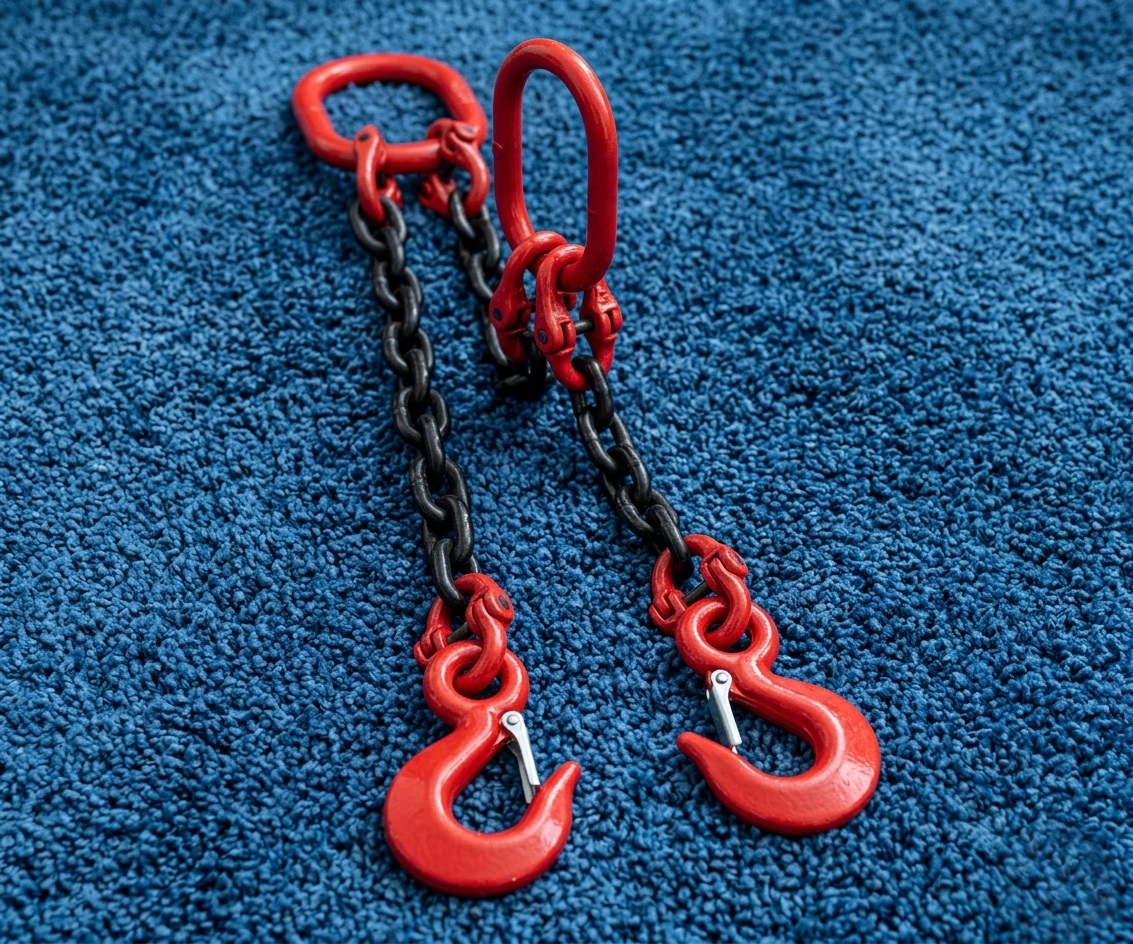
2 LEGGED CHAIN SLINGS
1. What is a Double-Legged Chain Sling?
A double-legged chain sling (also known as a 2-leg chain sling) is a heavy-duty
lifting assembly featuring two distinct lengths of high-strength alloy steel
chain connected to a single upper master link. The master link hooks directly
onto a crane or hoist, while the lower end of each leg is equipped with a
terminal fitting—such as a sling hook, self-locking hook, or grab hook—to
secure the load at two separate points.
Constructed
primarily from Grade 80 or Grade 100 alloy steel, double-legged
slings provide enhanced stability, balance, and load distribution compared to
single-leg designs, making them ideal for handling elongated, rigid, or
awkwardly shaped industrial materials.
2. Technical Features
- Dual-Leg Load Distribution: Shares the total weight of
the load across two separate chain legs, significantly reducing stress on
individual lifting points.
- Premium Alloy Steel: Manufactured from Grade 80
or Grade 100 steel, maintaining a standard 4:1 safety factor
engineered for rugged overhead lifting.
- Master Link with Sub-Links
(Optional but Recommended): High-capacity 2-leg assemblies often use a
master link assembly with smaller intermediate sub-links to ensure the
chain legs sit correctly and don’t jam under tension.
- Shortening Clutches / Grab
Hooks: Frequently
equipped with integrated shortening clutches or grab hooks, allowing the
operator to adjust the length of either leg independently to lift
unbalanced or uneven loads levelly.
- Rugged Environment
Resilience:
Impervious to UV radiation, oil, grease, and most chemicals. They maintain
full structural integrity at high temperatures (typically up to 200°C /
400°F without load reduction).
3. Common Uses and Applications
Double-legged
chain slings are the go-to choice when a load requires more than one attachment
point for balance:
- Steel Fabrication &
Stockyards:
Lifting long steel beams, heavy metal plates, pipes, and bundles of rebar.
- Machinery Installation &
Assembly:
Hoisting heavy industrial equipment, gearboxes, and large lathe machines
where weight must be balanced across two lifting eyes.
- Construction &
Infrastructure:
Handling pre-cast concrete blocks, columns, barriers, and modular
construction segments.
- Foundries & Heavy
Forging:
Transporting hot ladles, molds, and large castings through intense heat zones.
- Shipping & Logistics: Moving long crates,
containers, and structural components on and off cargo decks.
4. Key Advantages
- Superior Load Balance &
Control:
Using two lifting points prevents the load from spinning, tipping, or
tilting unpredictably during transit.
- Exceptional Versatility: Capable of executing
straight vertical lifts, basket configurations, or adjusted uneven lifts
via shortening clutches.
- High Resistance to Damage: Excellent resistance to
sharp edges, abrasion, and cutting, eliminating the need for heavy
edge-protection wear pads required by synthetic web slings.
- Completely Repairable: If one leg or hook sustains
damage, that specific component can be swapped out, repaired, and
recertified by a qualified inspector without needing to replace the entire
rigging assembly.
- Clear Capacity Rating: Every assembly features a
stamped metal identification tag indicating the Working Load Limit (WLL)
at specific lifting angles (e.g., 60°, 45°, and 30°).
5. The Critical Role of Lifting Angles
Unlike
single-leg slings, the capacity of a double-legged sling changes drastically
depending on the horizontal angle of the legs during the lift. As the
angle between the legs widens, the 
|
| Hitch Configuration |
Diagram / Geometry
|
Rated Capacity Behavior
|
|
| 
|
Ideal configuration; narrow
angle between legs.
|
Retains approx. 86% of
combined single-leg capacities.
|
|
| 
|
Standard working angle;
increased tension.
|
Retains approx. 70% of
combined single-leg capacities.
|
|
| 
|
Wide angle; high stress on
chain and master link.
|

|
Enquiry Now