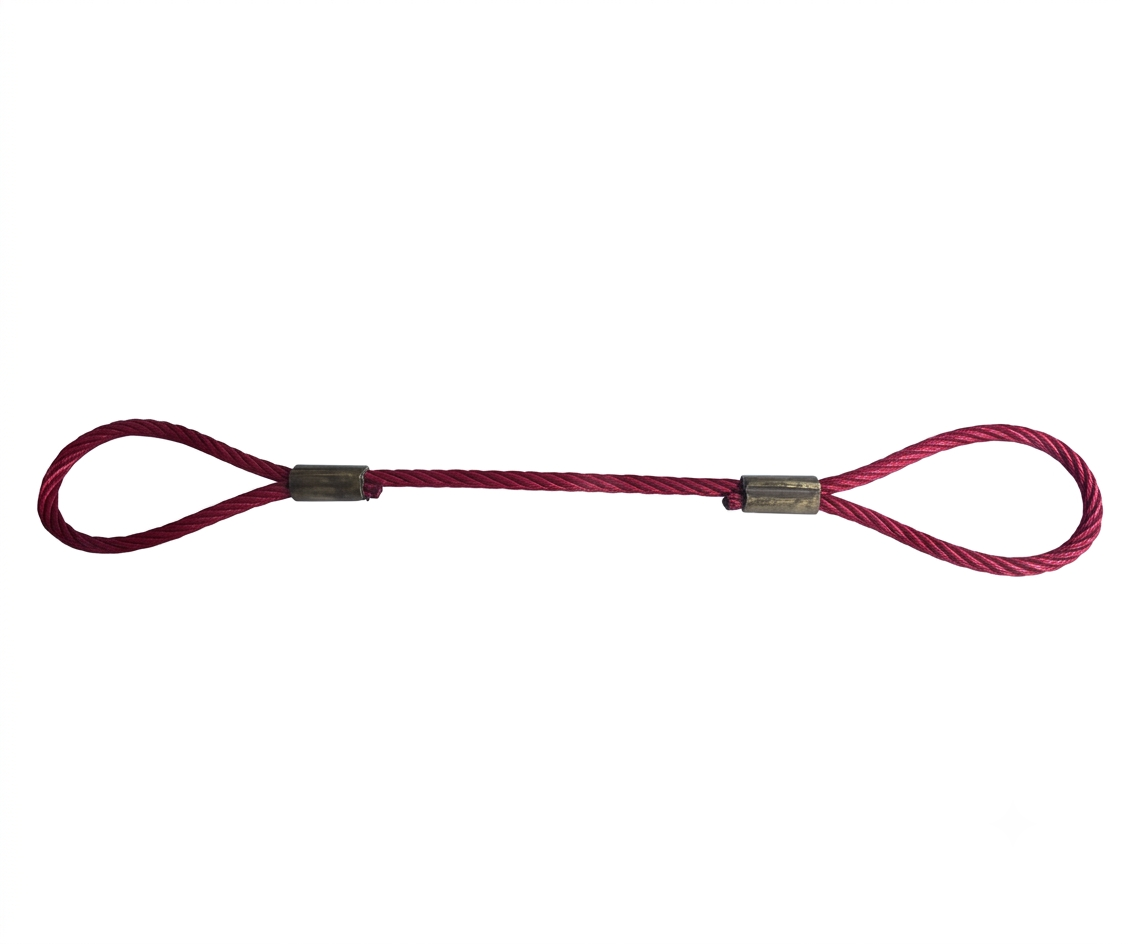
LIFTING WIRE ROPE SLINGS
1.
What
is a Wire Rope Sling?
A wire
rope sling is an exceptionally strong, rugged lifting assembly fabricated
by twisting multiple individual steel wires into strands, which are then
helically laid around a central core (fiber or steel). This complex braided
structure provides a balance of high tensile strength, flexibility, and
resistance to sudden failure.
The most
common industrial configurations include single-leg assemblies with
mechanically swaged (flemished) eyes at both ends, or multi-leg bridle setups.
Because of their rigid structure, they bridge the gap between the
ultra-flexible polyester webbing slings and the heavy, articulated alloy steel
chain slings.
2.
Technical
Features
·
Strand and Core Construction: Typically
manufactured in a 6 x19 or 6 x 37 classification. The IWRC (Independent Wire
Rope Core) offers superior strength and heat resistance, while a FC
(Fiber Core) provides enhanced flexibility.
- Flemished Eye &
Swaged Sleeves: The
lifting loops (eyes) are formed by splitting the rope end, looping it
back, and mechanically sealing it with a heavy-duty aluminum or steel
ferrule/sleeve. This maintains a standard 5:1 safety factor.
- Excellent Fatigue
Resistance: The
multi-wire design allows the sling to bend repeatedly over sheaves or
crane hooks without fracturing immediately.
- Gradual Wear
Warning: Unlike
synthetic slings that can cut instantly, wire rope wires break
individually over time, offering a clear visual warning during routine
safety checks.
- Temperature
Tolerance: Steel-cored
(IWRC) wire rope slings can operate safely in harsh environments up to 200°C
/ 400°F without any reduction in their Working Load Limit (WLL).
3. Common Wire Rope Accessories
A wire
rope sling rarely works alone; it relies on high-tensile rigging hardware to
connect safely to crane hooks and heavy loads:
- Thimbles: Heavy-duty steel inserts
placed inside the sling's loop (eye) to prevent the rope from crushing,
kinking, or wearing thin from direct friction against hooks or shackles.
- Rigging Shackles (D-Shackles
& Bow Shackles): Removable steel links secured with a pin,
used to anchor the sling eye securely to a load's lifting lugs.
- Wire Rope Clips (U-Bolts): Used to clamp two lengths
of wire rope together to form a temporary eye or lap joint when mechanical
swaging isn't possible on-site.
- Turnbuckles: Threaded rigging devices
used to adjust tension and precisely balance the leg lengths when handling
unevenly weighted industrial cargo.
- Sockets (Spelter & Wedge
Sockets):
High-efficiency terminal end connections used for heavy-duty anchoring
points on cranes or structural cables.
4. Common Uses and Applications
Wire rope
slings are highly versatile and widely deployed in massive lifting
applications:
- Oil & Gas and Off-Shore
Rigging:
Hoisting drill pipes, structural skids, and heavy maritime equipment in
highly corrosive marine environments.
- Heavy Construction &
Infrastructure:
Lifting massive pre-cast concrete beams, bridge sections, piling rigs, and
large steel frameworks.
- Steel Mills & Foundries: Handling coils of sheet
metal, bundles of structural steel, and raw metal billets.
- Shipbuilding & Ports: Transporting shipping
containers, large vessel hulls, and heavy industrial machinery off cargo
decks.
5. Key Advantages
- High Strength with Lower
Profile:
Considerably lighter and less bulky than an alloy steel chain sling of
identical capacity, making handling easier for riggers.
- Predictable, Observable
Failure:
Individual outer wires break gradually over time due to wear, allowing
inspectors to replace the sling before a catastrophic snapping
event occurs.
- Superb Kink Resistance: The robust steel lay design
prevents the sling from easily tangling or catching, maintaining its shape
over long-term industrial use.
- Excellent Cost-to-Strength
Ratio:
Highly affordable option for heavy industrial capacities (e.g., handling
loads from $5\text{ Tons}$ to well over $50\text{ Tons}$).
- Abrasion Resistant: Stands up far better to
rough concrete surfaces, metal scales, and dragging across warehouse
floors than synthetic web or round slings.
6. Standard Rigging Hitch Capacities
The
geometry of how a wire rope sling handles a load dictates its safe working load
limits:
|
Hitch Configuration
|
Description
|
Capacity Efficiency
|
|
Vertical Lift
|
A clean, straight line
connection from hook to load.
|
100% of rated WLL
|
|
Choker Hitch
|
The rope passes through its own
eye around the load, naturally tightening during the lift.
|
Reduced to approx. 70% to
75% of rated WLL
|
|
Basket Hitch
|
The wire rope cradles the load
completely with both eyes resting in the crane hook.
|
Increases up to 200% of
rated WLL (provided the legs remain perfectly vertical)
|
⚠️ Safe Rigging Reminder:
To avoid
permanent damage, never bend a wire rope sling around a sharp corner or pin
where the diameter of the curve is smaller than the diameter of the rope itself
(D/d ratio). Always utilize corner pads or split pipes to protect the steel
strands from sharp edge shearing forces.
Enquiry Now