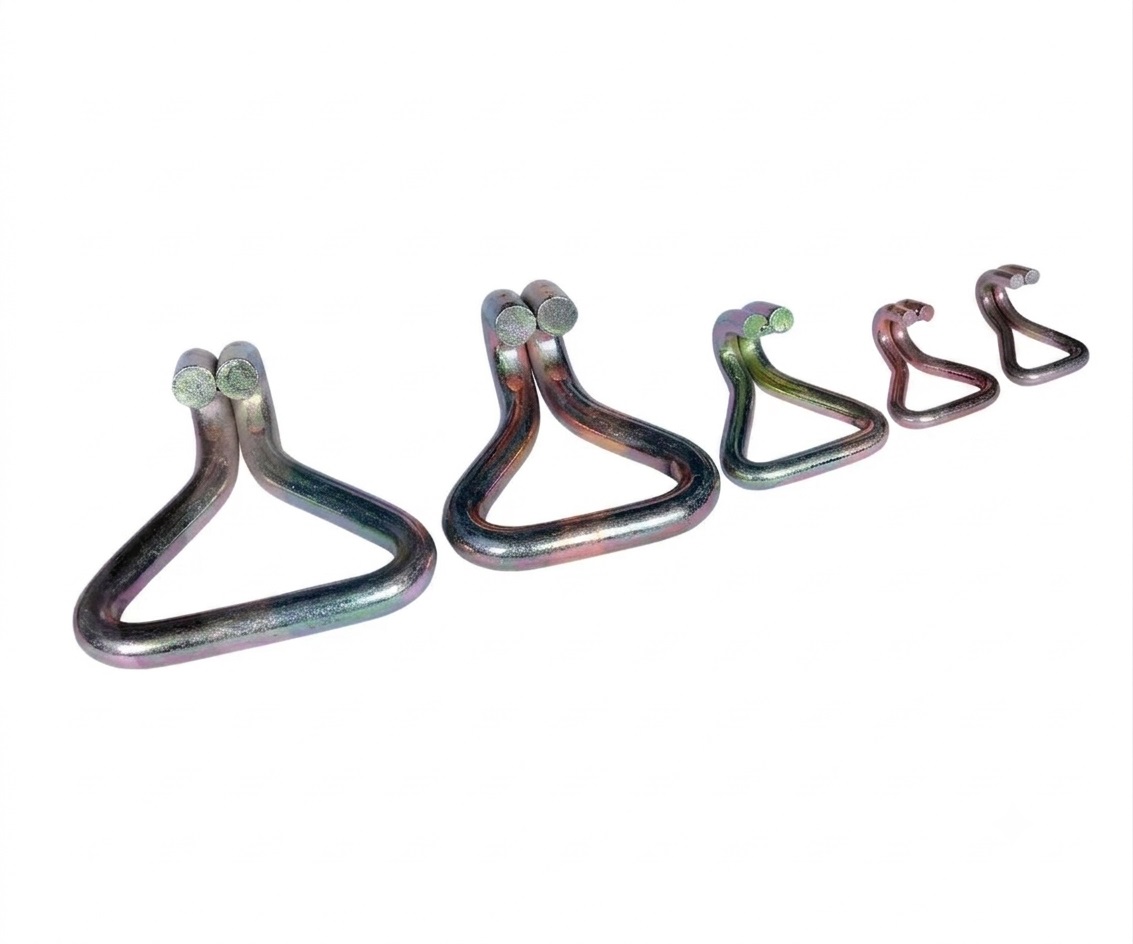
AGL034001-RATCHET HOOK
What is a AGL034001-RATCHET HOOK ?
A ratchet
hook (frequently referred to in heavy rigging as a self-locking hook
or positive-locking hook) is an ultra-secure, heavy-duty safety hook
used in industrial overhead lifting and high-security cargo lashing.
Its
defining feature is a mechanical, spring-loaded locking trigger integrated into
the back of the hook body. When a load is placed into the bowl of the hook, the
latch snaps shut automatically. The unique safety feature of this design is
that the hook cannot open while it is under load, even if the tension
momentarily slacks or hits a sudden obstacle. The latch can only be released
manually by pressing the flush-mounted trigger pin once the load has been
safely set down.
Constructed
from drop-forged Grade 80 or Grade 100 alloy steel, ratchet hooks
offer a premium upgrade in safety compared to standard latch hooks.
Technical Features
- Self-Locking Safety
Mechanism: The
gate automatically snaps shut and locks the moment tension is applied to
the hook, ensuring complete closure before a lift begins.
- Flush-Mounted Release
Trigger: The
locking trigger is recessed into the back of the hook body, protecting it
from accidental bumps or snagging against adjacent rigging hardware.
- Drop-Forged Alloy Steel: Fabricated using
heat-treated Grade 80 (T) or Grade 100 (V) alloy steel, providing an
exceptional strength-to-weight ratio and a strict 4:1 structural safety
factor.
- Varying End-Connection
Designs:
Available in multiple top-end configurations to connect seamlessly with
diverse rigging gear:
- Clevis Style: Features a pin-and-collar
design to connect directly to chain legs without a coupling link.
- Eye Style: Features a wide, rounded
eyelet for permanent attachment to wire rope sleeves, web slings, or
master links.
- Swivel Style: Features an integrated
rotating eye to allow the hook to spin under load, preventing chain
twisting.
- Fatigue-Rated & Stamped: Clearly stamped with the
exact chain size (e.g., 10mm, 3/8") and its corresponding Working
Load Limit (WLL) directly onto the forged body for immediate
inspection compliance.
Common Uses and Applications
Ratchet
hooks are mandated on many industrial worksites where the risk of a load
slipping or unhooking must be entirely eliminated:
- Overhead Crane Lifting
Slings:
Integrated as the terminal lower hook on single-leg, 2-leg, 3-leg, and
4-leg alloy chain slings.
- Tower Crane Operations: Used in high-altitude
construction rigging where wind forces, load spinning, or swaying could
cause standard latch hooks to fail or detach.
- Heavy Engine & Machinery
Moving:
Hoisting heavy gearboxes, industrial pumps, and generator assemblies where
the lifting points are irregular or hard to balance.
- High-Value Asset Lashing: Acting as the primary
anchor point on heavy transport tie-downs for aerospace components,
military assets, and luxury vehicles.
- Offshore and Marine Rigging: Deployed on shipboard
cranes and supply vessels where rough sea movements cause unpredictable
loading slack.
Key Advantages
- Foolproof Security under
Load:
Because the mechanical gate relies on the weight of the load to keep it
locked, it is physically impossible for the hook to open mid-air, making
it the safest option for overhead rigging.
- Zero Latch Damage/Bending: Standard sheet-metal safety
latches break or bend easily if hit sideways. The latch on a ratchet hook
is made of thick, forged steel that forms a structural part of the hook
tip, resisting high lateral impact forces.
- Faster Rigging Cycles: Operators can slip the hook
into a lifting eye and let go—the machine locks itself as it is raised.
There is no need for manual latch checking or inserting secondary locking
pins.
- Clear Wear Identification
Indicators:
Forged with distinct alignment marks on the body. If the throat of the
hook stretches beyond safe manufacturing tolerances due to overloading,
the marks will misalign, giving inspectors an instant visual cue to
discard it.
- Long Service Lifespan: Highly resistant to heavy
abrasion, severe impact, oil, and extreme industrial ambient temperatures
up to 200°C without any reduction in its structural working load
rating.
Comparison: Ratchet Hook vs. Standard Latch Hook
|
Feature
|
Forged Ratchet Hook
(Self-Locking)
|
Standard Lifting Hook with
Spring Latch
|
|
Locking Mechanism
|
Automatic. Gate locks under load and
cannot open under tension.
|
Manual. Sheet-metal latch keeps lines
from slipping but holds no load weight.
|
|
Latch Durability
|
Extremely High. Thick forged steel resists
bending and side-impact.
|
Low. Thin spring sheet can easily
bend or twist out of place.
|
|
Safety Profiling
|
Approved for high-risk,
critical overhead lifts.
|
General purpose lifting; prone
to bypassing if caught on an edge.
|
|
Disengagement
|
Requires an intentional, manual
press of the trigger pin.
|
Opens easily by pressing down
on the exposed spring tab.
|
Enquiry Now