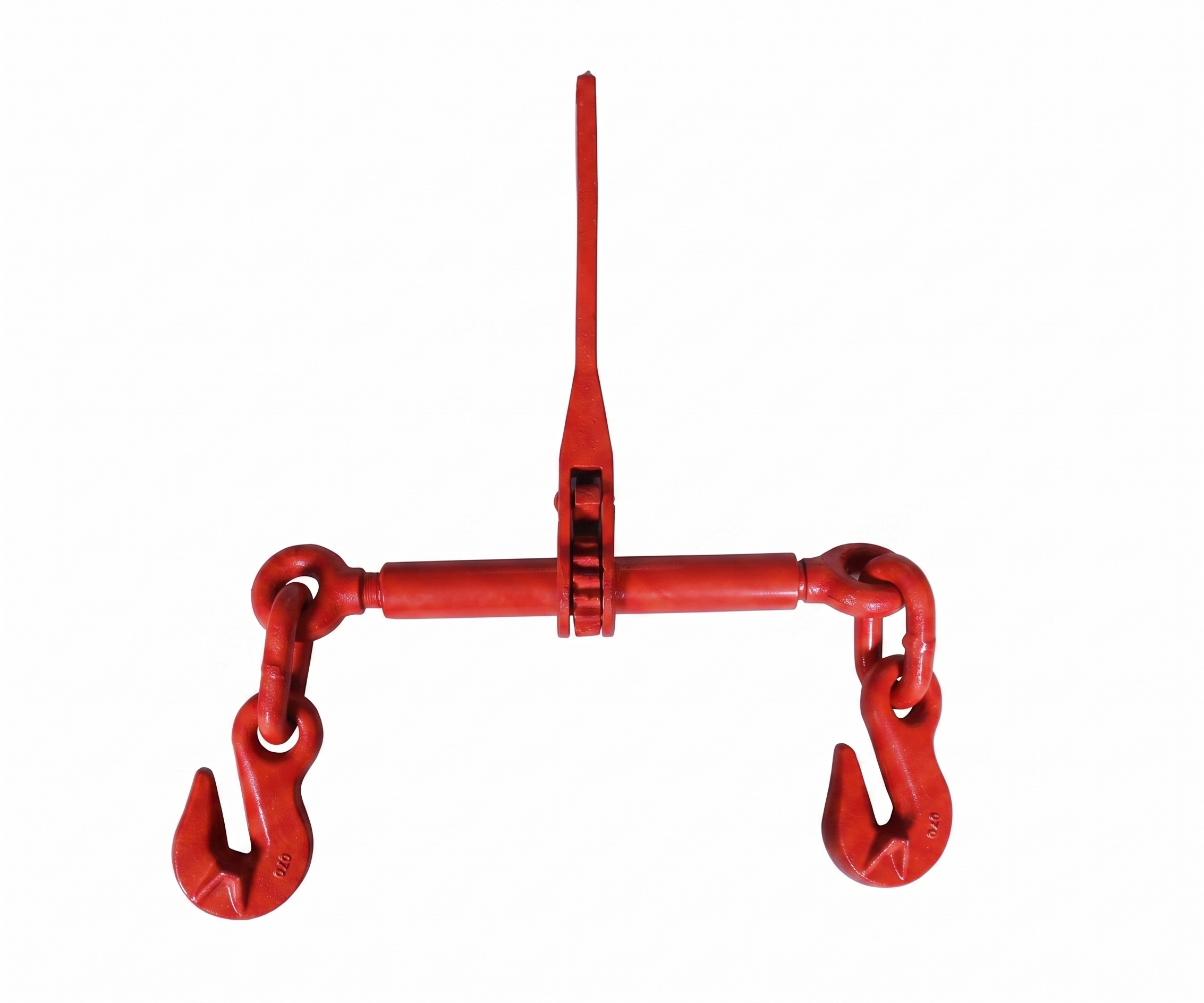
AGL03409-Lord Binder
A load binder (commonly referred to in logistics and industrial
heavy rigging as a chain binder) is a heavy-duty mechanical device used
to tighten and tension transport chains when securing exceptionally heavy
cargo.
While
ratchet straps are used for lighter materials, load binders are engineered
exclusively for high-tensile steel chains to ensure massive loads remain
completely immobile during transit.
1. Detailed Mechanical Breakdown (The Two Core Types)
Load
binders operate on a leverage or ratcheting mechanism to pull two tension hooks
together, drawing the slack out of a heavy-duty tie-down chain. They come in
two distinct designs:
A. Ratchet Binders (Highly Recommended for Safety)
- Mechanism: Uses a screw-thread
assembly, a gear, and a handle lever with a pawl system (just like a
ratchet).
- Operation: The operator pumps the
handle to gradually draw the heavy hooks inward, incrementally increasing
the chain tension.
- Safety: It does not store dangerous
kinetic energy in the handle, making it the safer industry standard.
B. Lever Binders (Snap Binders)
- Mechanism: Uses a simple over-center
lever arm to pull the hooks together.
- Operation: The operator pulls the long
handle down in one continuous motion until it snaps closed over the center
point, locking itself in place.
- Safety Note: It stores an immense amount
of energy in the handle during closing. If the handle slips or is released
prematurely, it can snap back violently, posing a severe injury risk to
operators.
2. Technical Specifications
Industrial
load binders are rated based on two chain sizes: the Working Load Limit
(WLL) for Grade 70 transport chain and Grade 80/100 alloy lifting chain.
|
Parameter
|
Standard Industrial
Specification Ranges
|
|
Material
|
Drop-Forged Heat-Treated Alloy
Steel
|
|
Surface Finish
|
Powder Coated (usually
high-visibility Red, Yellow, or Orange)
|
|
Compatible Chain Sizes
|
5/16" – 3/8" (most
common), 3/8" – 1/2", and 1/2" – 5/8"
|
|
Working Load Limit (WLL)
|
5,400 lbs (2,450 kg) to over
13,000 lbs (5,900 kg)
|
|
Proof Load / Break Strength
|
Typically 3x to 4x the Working
Load Limit (Design Factor 4:1)
|
|
End Fittings
|
Heavy-duty forged Grab Hooks or
Clevis Pins on both sides
|
3. Common Uses & Industrial Applications
Load
binders are deployed anywhere heavy machinery or high-mass materials must be
secured rigidly to transport beds:
- Heavy Machinery Transport: Tie-down securing of heavy
earthmoving equipment (excavators, bulldozers, backhoes) and military
vehicles onto low-bed or flatbed trailers.
- Steel and Pipe Hauling: Securing massive structural
steel beams, heavy industrial steel coils, and large-diameter concrete or
iron pipes.
- Logistics & Shipping
Containers:
Anchoring high-tonnage cargo, heavy power transformers, and industrial
generators inside flat-rack ocean containers.
- Timber & Forestry
Logistics:
Binding massive tree logs tightly onto logging trucks to prevent shifting
on uneven off-road logging routes.
4. Key Advantages of Load Binders
- Massive Load-Bearing
Capacity:
Engineered to handle structural loads weighing several tons. When paired
with G70 or G80 steel transport chains, they provide a level of tensile
strength that textile straps simply cannot match.
- Zero Elastic Stretch: Unlike polyester webbing,
which can stretch slightly under heavy dynamic shifting, high-tensile
steel chain and forged load binders have virtually zero stretch,
guaranteeing the cargo remains firmly in place.
- Extreme Mechanical
Advantage: The
leverage of a lever binder or the gearing system of a ratchet binder
allows a single operator to manually generate thousands of kilograms of
holding force without requiring external power tools.
- Maximum Durability in Harsh
Environments:
Drop-forged alloy steel can withstand extreme operational abuse, sharp
metal edges of the cargo, weld spatters, mud, ice, and intense heat
without degrading.
- Infinite Re-tensioning
(Ratchet Type):
Ratchet load binders allow for infinite micro-adjustments. If the chain
requires minor tightening mid-journey, the operator can easily give the
handle a few clicks to lock it back down safely.
Enquiry Now