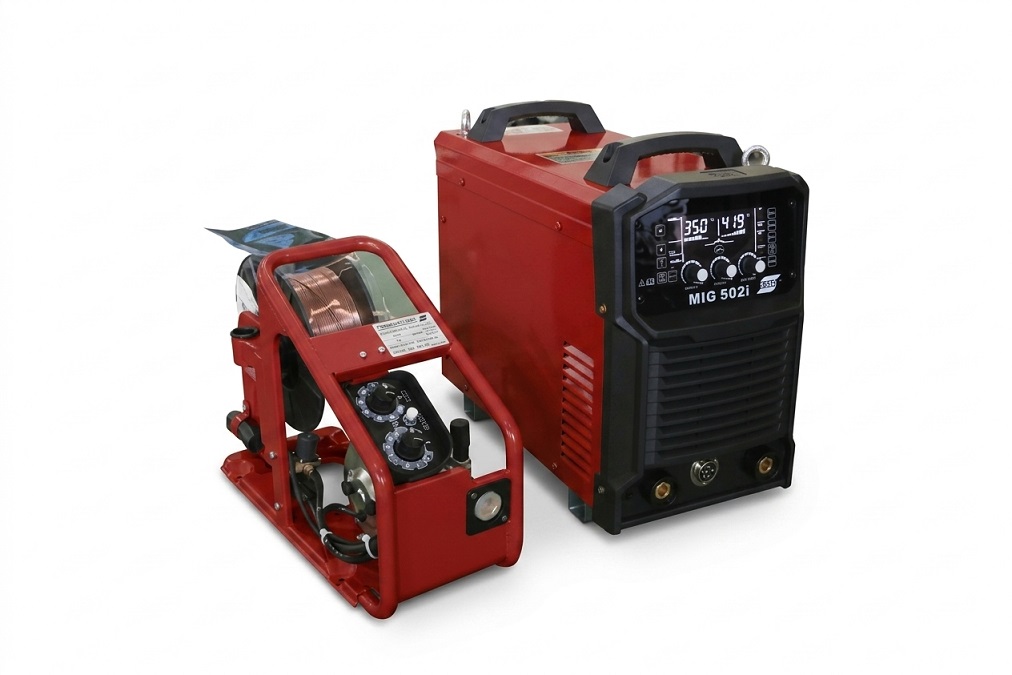
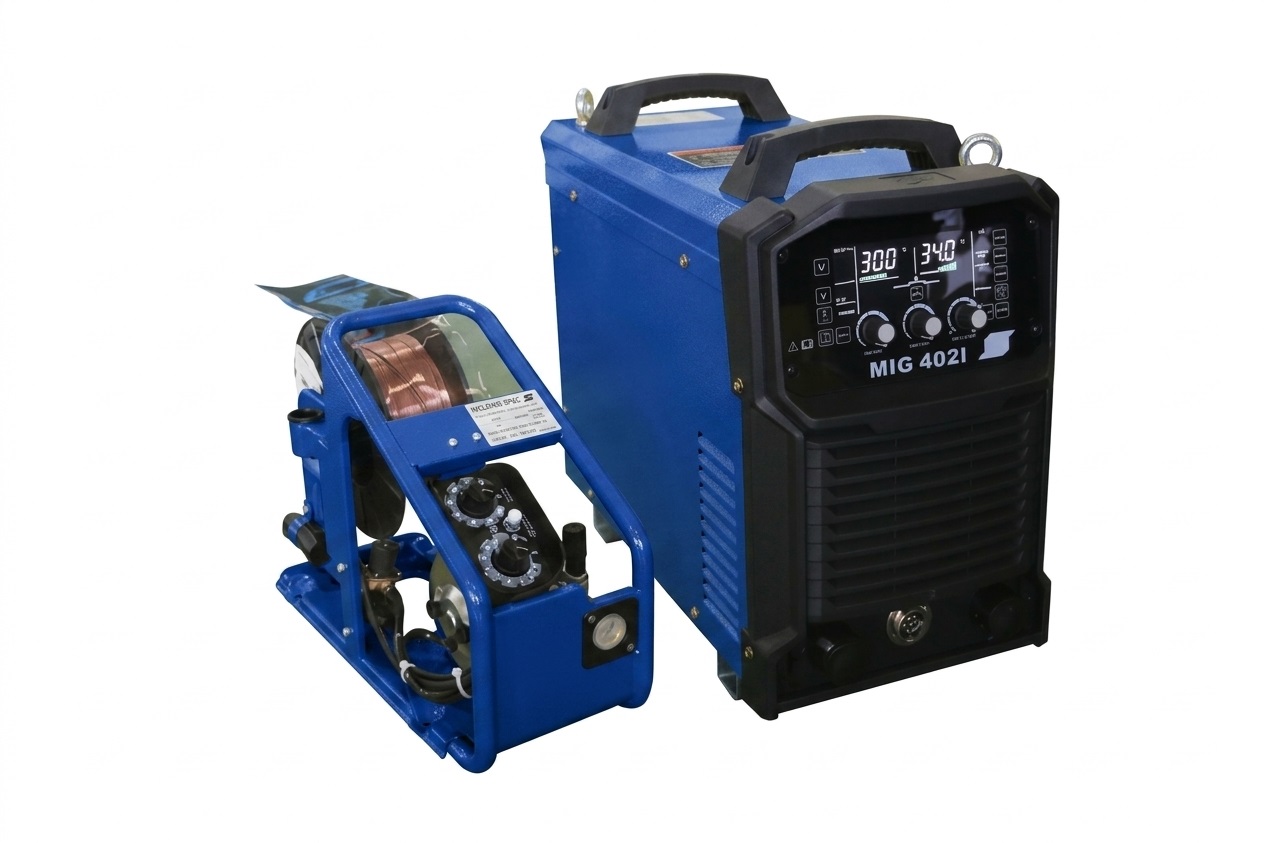
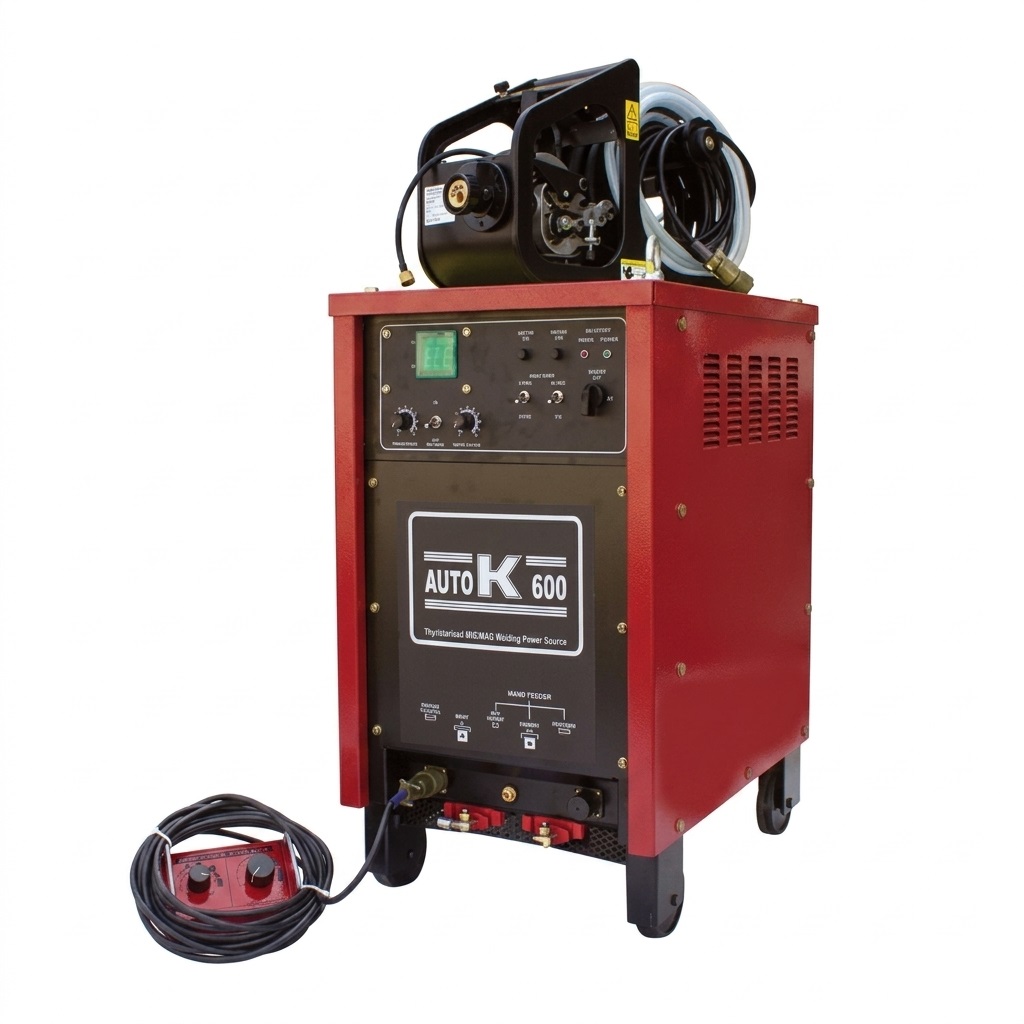
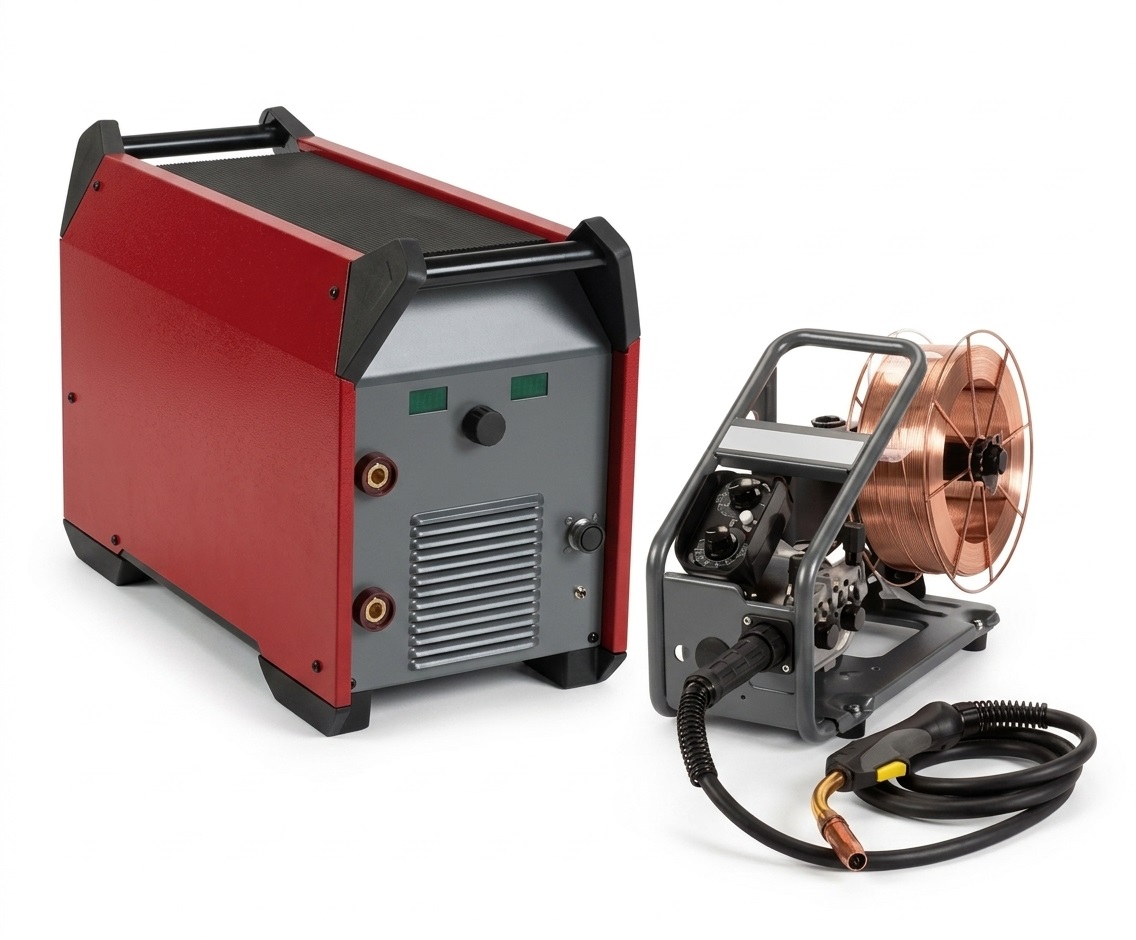
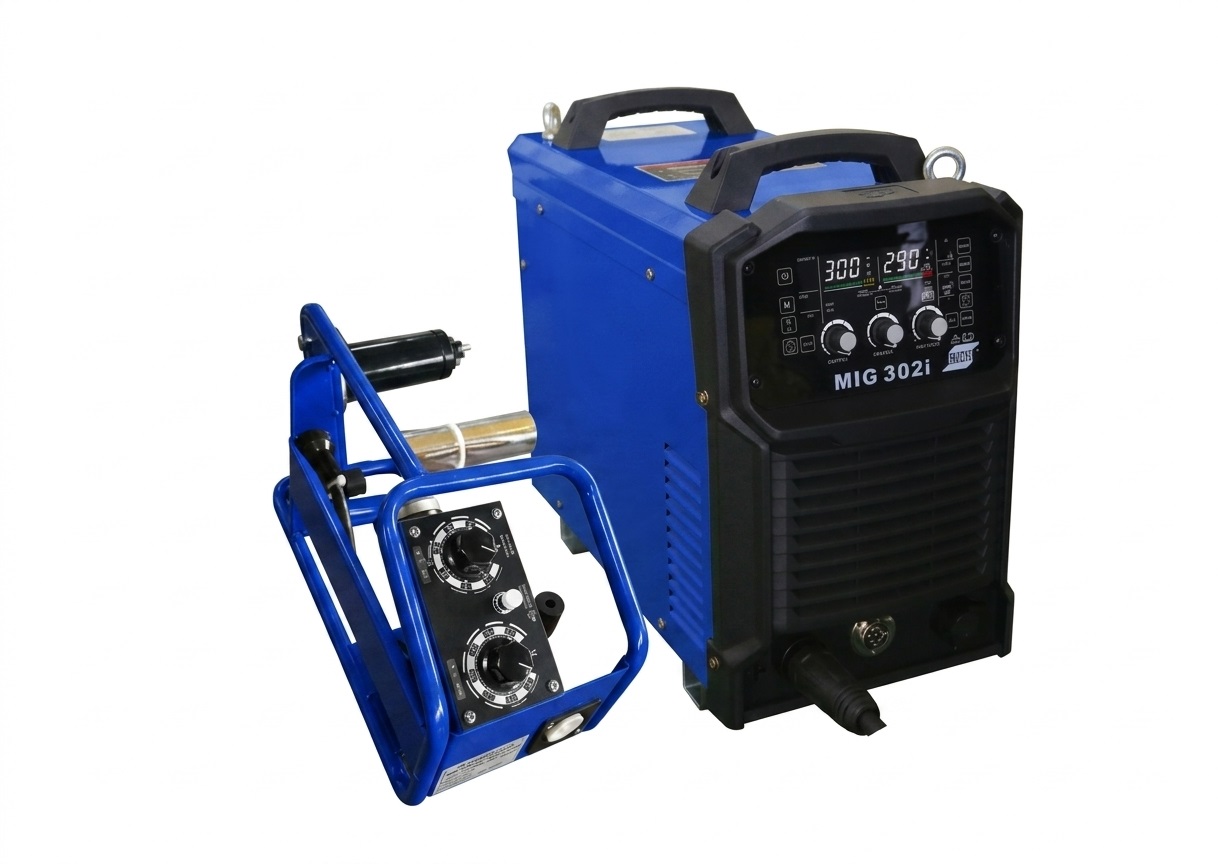
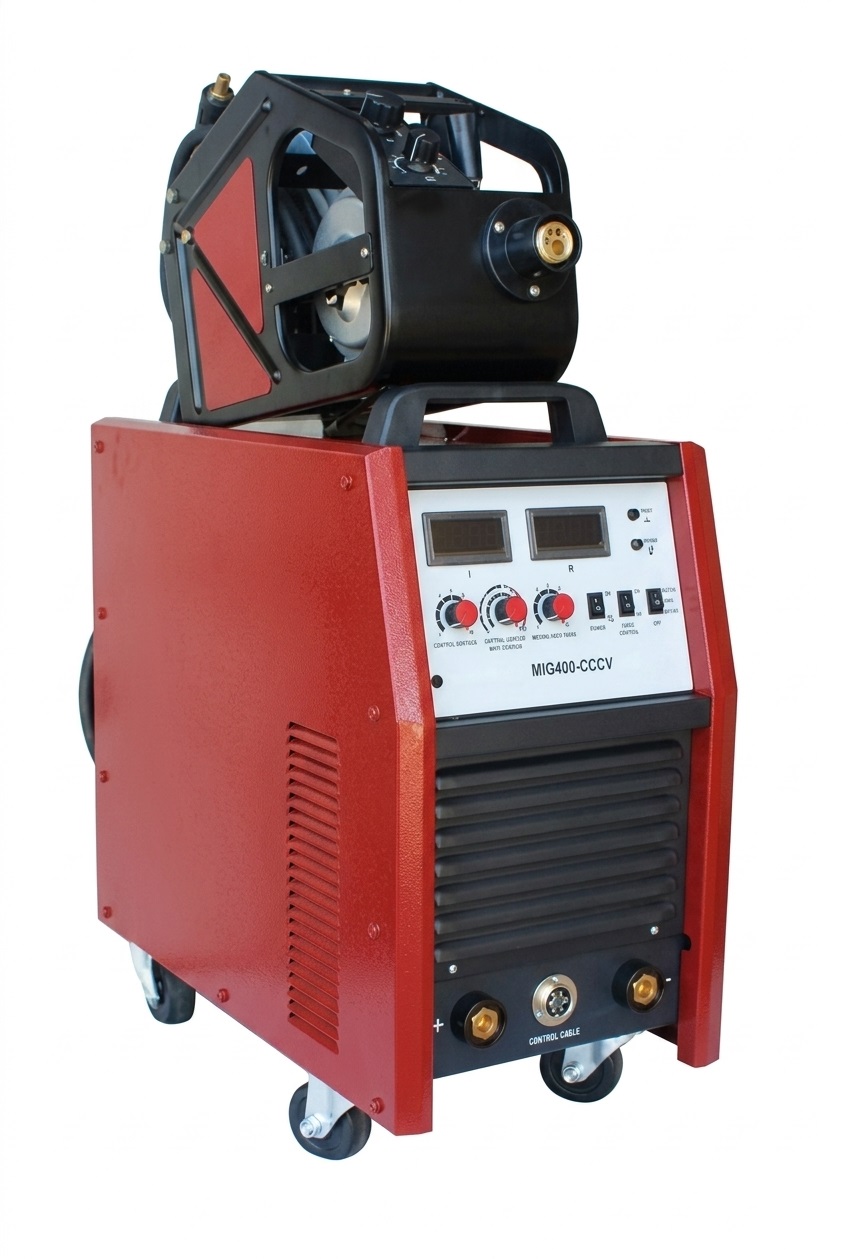
What is a MIG Welder (GMAW)?
MIG Welding,
which stands for Metal Inert Gas welding—and is formally designated as Gas
Metal Arc Welding (GMAW)—is a semi-automatic or automatic arc welding
process. In this method, a continuous, consumable solid wire electrode is fed
automatically through a welding gun from a motorized spool.
An electric arc forms between this wire
electrode and the metal workpiece, melting them together to create a joint.
Simultaneously, an externally supplied shielding gas (typically Argon,
$\text{CO}_2$, or a blend of both) flows through the welding gun to protect the
weld pool from atmospheric contaminants like oxygen and nitrogen, which would
otherwise cause porosity and weaken the joint.
Because of its continuous wire feeding
mechanism and ease of operation, it is widely considered the most productive
and versatile welding process in modern manufacturing.
Technical Features
- Continuous
Wire Feed System: Operates using a motorized
wire feeder (integrated or external) featuring a 2-roll or 4-roll drive
system that pushes solid or flux-cored wire at a consistent speed
($\text{m/min}$), eliminating the downtime associated with changing stick
electrodes.
- Constant
Voltage (CV) Power Source: Most MIG
power sources utilize a CV slope. This means the machine automatically
adjusts the welding current (Amperage) to maintain a preset arc length and
voltage, even if the welder's hand distance varies slightly.
- Shielding
Gas Delivery Module: Uses an integrated gas
solenoid valve that regulates the flow of shielding gas directly to the
torch nozzle. Common gas options include:
- Pure
$\text{CO}_2$: Highly economical, provides
deep penetration, but increases spatter.
- Argon
/ $\text{CO}_2$ Mixtures (e.g., 80/20):
Provides a highly stable arc, premium bead appearance, and minimal
spatter.
- Multiple
Metal Transfer Modes: Depending on the voltage and
current settings, the metal can transfer via:
- Short-Circuit
Transfer: Ideal for thin sheets and
out-of-position welding.
- Globular
Transfer: Good for deep penetration
on thick carbon steel.
- Spray
Transfer: High-speed, high-deposition
mode for thick plates in flat positions.
- Inverter
vs. Thyristor Topography: Modern
industrial MIG machines are built using advanced IGBT Inverter
technology for microsecond arc correction and energy efficiency, while
older variants rely on rugged Thyristorized transformer circuits
for high voltage tolerance.
- Integrated
Crater Fill & 2T/4T Control: Advanced
units allow users to program specific voltage/current step-downs at the
end of a weld pass (crater filling) to prevent cooling cracks.
Primary Uses and Industrial
Applications
MIG welders are the primary choice across
nearly every industrial sector due to their high deposition rates and
automation readiness:
- Heavy
Structural Steel Fabrication: Welding
I-beams, trusses, columns, and built-up sections for industrial
infrastructure and pre-engineered buildings (PEB).
- Automotive
& Transportation Industries:
High-speed assembly lines for vehicle chassis, car body frames, exhaust
lines, utility trailers, and railway rolling stock.
- Shipbuilding
and Maritime Modules: Multi-pass welding of thick
steel hulls, deck plating, barges, and offshore oil rigs.
- Sheet
Metal Fabrication Yards: Fast,
clean welding of enclosures, control panels, server racks, ventilation
ducting, and steel furniture.
- Heavy
Equipment Maintenance & Hard-Facing:
Re-surfacing worn earthmoving equipment, reinforcing mining excavator
buckets, and overhauling agricultural machinery.
Key Commercial & Operational
Advantages
- Unmatched
Production Speed (High Deposition): Because
the wire feeds continuously from an $18\text{ kg}$ or larger spool,
operators do not have to stop every few inches to discard a stub (as in
Stick/SMAW welding), drastically increasing duty cycles and throughput.
- Minimal
Post-Weld Cleanup: Produces an exceptionally
clean weld bead with little to no slag formation. This slashes secondary
labor costs associated with chipping, grinding, and wire-brushing.
- Ease
of Operation (Low Learning Curve): Since the
machine handles the arc length adjustments automatically via CV control,
standard operators can learn to produce high-quality, defect-free welds
much faster than manual TIG or Stick processes.
- Superb
Material Versatility: Capable of welding a massive
spectrum of industrial metals, including mild steel, low-alloy steel,
stainless steel, and aluminum, simply by changing the wire spool, liner,
and shielding gas.
- High
Deep-Joint Penetration: Excellent
for structural joints requiring deep, structural welds. It allows for
reliable multi-pass filling on thick plates using large-diameter wires (1.2mm
to 1.6mm).
- Long-Distance
Field Flexibility: Utilizing a separate,
external wire feeder allows the heavy power source to stay parked on the
factory floor while the lightweight feeder is carried up onto scaffolding
or inside large storage tanks.